Tuesday, July 23, 2013

Superior Carnage #1 Review: Not a Lot of Superior, Not a Lot of Carnage

Superior Carnage #1 Review: Not a Lot of Superior, Not a Lot of Carnage. 
By Orion Petitclerc 

Cletus Kasady, a.k.a. Carnage. This guy is one of Spider-Man’s deadliest foes, and arguably one of the most cult-popular characters in comics next to his daddy and the first Marvel symbiote, Venom. But with a gap of inactivity between his golden years of the mid 90’s and his short-lived (pun intended) reappearance in 2004’s Mighty Avengers, it felt like Marvel didn't know what to do with the poor serial killing symbiote—until he was resurrected in 2010’s limited series Carnage: Family Feud. Pop went the weasel, and suddenly a new limited series featuring the man in red and black popped up every year after as his popularity was rekindled, all leading to a rumored reinvention in Superior Carnage.

Rewind about nine months to the finale of Carnage’s previous tie-in limited series, Minimum Carnage, where Superior Carnage begins. After almost destroying the Microverse in Cullen Bunn (Venom) and Christopher Yost’s (Scarlet Spider) blast-from-the-past story, Carnage, Agent Venom (Flash Thompson), and the Scarlet Spider (Peter Parker’s reformed clone, Kaine) return to our normal-sized Huston, Texas for one last fight. Kaine finally had Cletus weakened and at his mercy, and “solved” the Carnage issue (or, rather, Cletus Kasady issue) once and for all with a swift and reader-shocking lobotomy using Kaine’s wrist stinger— completely ignoring Thompson’s newly-adopted “no killing” mantra ol’ Peter “not-yet Superior” Parker infected him with in Carnage U.S.A.  
"Kaine got the memo. Seems Spidey and Agent Venom didn't."

"Seriously, why are we following
this guy's narrative when we all know
Carnage is going to murder him?"
Fast-forward to issue one of Superior Carnage, where Kevin Shinick picks up the pieces and weaves his own, twisted web for the symbiote-powered vegetable. Shinick tells the first nine pages of the story through the brown-stained woes of…some nobody named Ted Connelly who summarily dies on the toilet nine pages later by a red noodly appendage (guess whose?).


The symbiote geek in me wonders why these weren't nine pages filled with carnal goodness, but as a writer I get what Shinick’s up to. We, the readers, are supposed to be Ted, who’s a non-super, white collar criminal unfortunate enough to earn himself a cell next to Carnage’s in an “Undisclosed Containment Facility” because of an unnamed governor’s plan to quick-fix a prison overcrowding issue. If it weren't for Ted being constantly surrounded by physically bigger super villains, I would've never guessed he was in a prison built for supers— what, with the cell guards wielding normal-looking guns that would have little effect with many of the inmates; the highly-inefficient key code-locked cell doors the guards have to seemingly punch in every now and then to keep the monsters at bay; and the waves of normal-looking inmates running from Carnage once he breaks loose.
"Someone didn't do their homework, kids."

Man, this prison needs to be shut down faster than…oh, wait, the Raft was already decommissioned and emptied as of Superior Spider-Man #13? Hmm, if this facility were located in New York, I’d think Mayor Jameson would have it next on his Gitmo hit list.

"When has this technique ever worked on Carnage?
Well...how about now?"
Ted flashes us back a month before the events of Superior Carnage when Cletus arrives at the prison escorted by none other than Agent Venom, revealing that he overheard a conversation about Cletus’ lobotomy between Agent Venom and the cloaked prison official wheeling Cletus around in a friggin’ wheel chair wearing a straight jacket. Need I mention how inefficient this method of containment was in the beginning of Maximum Carnage back in the 90’s? No? Okay. Anyways, I guess Cletus’ not-lobotomized psycho symbiote decides to keep it cool during this scene and not kill everyone while it had its chance, and we flash forward again to the present, where one of the cell guards taunts Ted’s hair-trigger bowels until he gets mind controlled into releasing Carnage from his cell. Then Ted dies. Sweet mercy.


"Oh yeah, this nerd!"
At this point, Shinick introduces the Wizard into the fray as the man behind the curtain of chaos with Game of Thrones joke. I don’t like to think of myself as one, but you can consider me a “new reader” to most things Marvel that has nothing to do with symbiotes and Moon Knight. I can guess the Wizard is not one of Marvel’s better-known super villains, and my knowledge of him extends no farther than beating him to a bloody pulp in Marvel Ultimate Alliance 2. So when he says he’s no stranger to mind control, that’s about as much as I know about his power set. Hopefully Shinick will amend this by the end of the five-issue limited series. Making me care about the character is a whole other story altogether.
an unfunny

"I wouldn't have expected any less from this match-up."

Rather than only incapacitating the prison control room guards and opening all the doors as some hackneyed plan of escape, however, the Wizard has Carnage in his sights, recognizing the biggest player in the fray. Like any good villain, the Wizard likes to reveal his master plan at the most inappropriate time (in this case: the beginning of the limited series). I could’ve done with some mystery in the master plan, Shinick, but—woe is me—Marvel’s spoilerific solicitations already ruined the fun in guessing. Oh well, cat’s out of the bag.

Citing his unnamed insiders, the Wizard reveals to his captive audience (wah-wah) that he heard about how the government took the Venom symbiote and made a super soldier out of some lucky bastard (Flash, if you weren’t aware). Not only does the Wizard want to get the gang back together in a new Frightful Four team (who now?), but he wants to take the Agent Venom formula and perfect it by making…drum roll…the Superior Carnage! Where he thinks the government went wrong with Agent Venom (because they ended up “failing,” as he puts it) is explained in two of the best sentences in the book: “Because you don’t harness evil and make it good. You harness evil and make it wicked!” Poetry, pure and simple. I like Shinick already.

The Wizard gets interrupted by one of the guards, mentions he has a son, yadda yadda, and then kills his captives and heads down into the action “to tame the beast.” Uh huh, good luck with that, dweeb. He meets up with Carnage, gets all confident, and right as Carnage charges for him and the Wizard tries to mind control Cletus—uh oh! Looks like Oz forgot to give Mr. Kasady a brain. Silly wizards and their pranks. What really gets me, though, is that the Wizard didn't know about Cletus’ condition beforehand…say, when Ted’s loud thoughts were interfering with his mind control. But then again, mind control and mind reading are two separate things…oh, psychic stuff has always been a jumbled mess to me.

"And I thought Klaw couldn't look any dumber..."
Anyways, the Wizard realizes his mistake too late as Carnage jumps onto him. Right as Carnage is about to bite his head off, the symbiote explodes into a painful fury as Cletus gets blasted in the back on a sweet double-page spread. The Wizard reveals again that Carnage was supposed to be the Frightful Four’s secret weapon, but out of the dust walks Klaw, one of, if not the Wizard’s first recruit. Again, I know next to nothing about Klaw outside of his appearances in the Avengers: Earth’s Mightiest Heroes cartoon, but thankfully Shinick lets us know Klaw’s pulpy title of the “Master of Sound”. Looks like the Wizard did his homework on symbiote weaknesses. Good for him.

And thus the first issue ends with a (silent, onomatopoeia-less) bang as the third member of the new, superior Frightful Four lineup is revealed. After the adrenaline-fueled symbiote geek excitement wears off, I find myself disappointed that there wasn't more Carnage in the first issue of his own book (‘Nam flashbacks of Daniel Way’s Venom run and the first two issues of Carnage: Family Feud ensue). The first half of the book was just Ted complaining about his prison-world problems, and the last half was the Wizard going over his evil master plan. It felt like Carnage was pushed into the background and was used as a device to move Ted and the Wizard’s stories forward. Remind me whose name is on the cover, again?

Then again…“Dave’s not here, man.” Cletus is brain-dead. The Carnage symbiote, as history tends to prove, barely has a voice of its own. Could a Carnage book really carry with a lobotomized savage as the main character? It could, but not easily, and probably not profitably if it weren't for Carnage’s inherent popularity. So I understand Shinick’s use of alternate narrators and making the Wizard the main character. I think a better title for the book would've been Superior Frightful Four, but I have a hope that things will turn around at some point and Carnage will take the center stage once more.

As for the Superior part of the title, nothing in this first issue links the story to the Superior Spider-Man title in any way. Is the Wizard’s motivation for resurrecting the Frightful Four to menace Spidey in some way for some reason? I've been following Superior Spider-Man since Amazing Spider-Man #699.1, and nowhere is the Wizard or Klaw even mentioned. Were they involved in Spidey’s immediate past, pre-Superior? I don’t know. I’m a new reader (so to say). Will Spidey even show up in this series? The solicits promise this is a tie-in to Superior Spider-Man, so I guess that’s a “yes,” even if there’s nothing Superior in this first issue so far.
"That book features Spider-Man.
That book does, too.
That book guest stars Spidey.
And Scarlet Spider...well, he's a Spider-Man.
So where's Spidey in this one?"

"Seriously, did no one else catch this?"
I like what I’ve read so far, even though I have my own little symbiote geek issues with the book, and I’m putting my trust in Shinick as I've done before with Bunn, Yost, and Zeb Wells. I am very pleased to see Clayton Crain—a Carnage alumnus—back illustrating the cover, and as much as I miss his organic interiors (that wasn't meant to be creepy, I swear), Stephen Segovia (art) and Jay David Ramos (colors) pick up the bill just as well. The colors could have been a bit darker and grittier for my tastes (this is a book with “carnage” in the title, after all), but Segovia’s style happily reminded me of the dominating comic art styles of Marvel in the 90’s while fusing some more modern techniques to keep it fresh. I did find it funny, however, that Segovia’s classic Venom on the beautiful page 12 spread resembled very closely Kotobukiya’s Venom Unbound fine art statue. How striking, the resemblance…. Also, I’m very happy Segovia and Ramos fixed Cletus’ look from his last appearance in Minimum Carnage. That was not Cletus Kasady.

 "That's not Cletus Kasady! It's Emil Blonsky, a.k.a. the Abomination as played by Tim Roth!
THIS IS NOT THE VILLAIN WE'RE LOOKING FOR!"

BOTTOM LINE: Superior Carnage #1 gets 4.5 stars out of 5 for Segovia and Ramos’ title-appropriate interiors, and 4 stars out of 5 for Shinick’s flowing bait-and-switch, alternate narrator story. Overall, I give the book 4 stars out of 5.

Friday, May 3, 2013

20 Years of Maximum Carnage: PART 1

Part I: Spider-man Unlimited #1
The explosive first part, this debut issue sets the series off on a good foot.
Kasady is being wheeled through the halls of Ravencroft, strapped to a gurney. You have to remember that Carnage is still a brand new villain, and law enforcement has no idea what his powers are. We learn in Venom: Lethal Protector that it was known that Carnage is the spawn of Venom, and Venom by this time has been in jail several times. But this knowledge, for some reason or another, has not been shared with the Ravencroft staff, and they think that they are just dealing with another run-of-the mill lunatic (you'd think they had at least read the newspaper reports of Carnage throwing helicopters off buildings and holding off two other super-powered beings at the same time). One of the doctors claims that he ran around in a "garish red suit," as if Kasady had been running around in a Mario costume. When she goes to take his blood, well:
As time went on, Carnage's "ultimate insanity" persona would get old, as it never really was developed. Yet at this time, it was quite fresh; there had never been a Spider-Man villain as amoral as Carnage. The only problem with this opening scene is that I think the coloring should have been a bit darker; the bright shades kind of ruin the mood.
Before we go on, I think I need to elaborate on the symbolism of Carnage in the Spider-Man mythos. A number of classic Spidey villains are metaphors for larger social issues of the time.
Chameleon represented Red Scare communist infiltration.
Vulture represented the Generation Gap of the 60s.
Doctor Octopus represented the fear of nuclear technology.
Lizard represented science run amok.
Mysterio represented the growing power of mass media.
Kingpin represented the explosion of organized crime in the late twentieth century.
Venom could possibly be seen as an indictment of America's mental health system, and possibly the lures of drug abuse (the symbiote can be seen as a form of drug).
Carnage was a metaphor for the way many people viewed society at the time. It is no coincidence that lethal anti-heroes were popular in the late eighties and early nineties. Urban crime was at an all-time high, and many people couldn't think of any way of bringing it down. Such fears can be seen in moves at the time like Predator 2 and the Robocop series. Silver Age values seemed quaint and useless under these circumstances; why lock up criminals who will again just be loose on the streets when you can end things permanently? Carnage was a metaphor for the nihilism that seemed to be engulfing the US. His creed of the law being useless struck many as the reality, and traditional superheroes like Spider-Man could only combat such evil by teaming up with an equally ruthless being in the person of Venom. While Maximum Carnage is a dark story, the first Carnage arc is even darker, and really brings out how different Carnage is from Spider-Man's more traditional villains. There is a perpetual sense of doom throughout it, as Carnage simply hunts and murders random people for fun, and Spider-Man initially is powerless to stop him. When the story ends, there are no witty remarks, just the hero walking into the dark in disgust. Silver Age Spider-Man was now immersed in the urban jungle of the early nineties, and the rules had changed.
Getting back to the story, we pan over to the wake of Harry Osborn. He had of course "died" from a heart attack due to a bad reaction from Norman Osborn's goblin formula in Spectacular Spiderman #200. That story was a Spider-Man masterpiece and classic, and I personally believe that retconning it was worse than what happened to the marriage, but I digress. While it's clear everyone's sad, a few people can't help but notice that Harry's stint as the Green Goblin led to a low turnout for his funeral. Jameson of course thinks Spider-Man is somehow to blame for everything. In an example of how comic book characters don't have to have fixed personalities, we see the Molten Man (he looks kind of silly in a tux) providing emotional support for his cousin Liz Allan. This is the same guy that years before was robbing jewelry stores and fighting Spider-Man in the dark while in his underwear. Peter of course has his usual guilt syndrome, and believes that Jameson might be partially right. This attitude to be expected from Peter, and it's a bit cliche, but given how wrapped he was in Harry's problems and the Green Goblin legacy, his feelings are actually quite understandable. The one thing that Maximum Carnage got 100% right was Peter's characterization, and how his strict moral code does not allow him to just explain things away that he's not comfortable with.
It's important to note that Harry never gets a proper send-off or tribute issue, despite having been such an important supporting character. Probably for this reason, for the rest of Maximum Carnage, we repeatedly hear how powerful his death was and how sad Liz is. Over and over again. It begins to lose its emotional impact on the reader after a while, and because of this, I don't think jumping straight from his death to Maximum Carnage was the best idea. What is done right is the dynamic between the Liz, Peter, and Mary Jane, especially Liz and Mary Jane. While MJ does indeed prove to be a good friend during this terrible time for Liz, there's always the tension in the back of her mind that during the time Harry was the Green Goblin, Liz and Mary Jane's husbands were mortal enemies, and the reader really sees the guilt she feels.
But enough of that; back to Carnage. While massacring the Ravencroft inmates for fun, he decides that instead of letting himself be chased by Spider-Man and Venom, he'll go after them. This is one of the few times I think the readers have ever seen criminals at Ravencroft who don't have any superpowers. It's also quite clear the Ravencroft has not put into place the safeguards needed to contain super-villains. Suddenly, he's distracted by one of the inmates actually cheering him on.
Enter Shriek; a bizarre female prisoner who's just as insane as Kasady, and who wants to join him on his rampage. One cannot help to get the feeling that Marvel was trying to create a Joker/Harley Quinn dynamic. You have to give credit for the artists in actually being rather restrained in designing her. You have to remember that this was the era of Rob Liefeld, where women has breasts the size of basketballs, absurdly curved backs, overly pouty faces, enough ass to give Sir Mix-a-Lot a heart attack, and generally wore incredibly unrealistic skimpy clothing. Shriek, while definitely being attractive, is not overdone in her features and outfit. There is far more emphasis on her being spooky and slightly seductive, rather than just having outright sex appeal.
Intrigued, and attracted to her, Carnage decides to spare her life and allow her to join him. As they travel across the city, he tells her just how he came to be, giving important information as to how the symbiote apparently survived its destruction at the hands of Spider-Man. Apparently, in the course of the battle, Kasady was cut and the symbiote melded with his blood, making the symbiote part of his own body. The costume (at least for the moment) is no longer a separate creature, but just an extension of Cletus. Shriek, for her own part, seems to have gotten her powers from a combination of drug use and a run-in with a certain superhero (you find out who later on). She tends to use this weird jive turkey slang that I can't quite put my finger on, and it sometimes makes it hard for you to know just what she's talking about.
In an alleyway, they encounter another dangerous being; the Doppelganger, a monstrous alien mirror image of Spider-Man created during the Infinity Wars. Doppelganger is a mindless creature whose only real claim to fame is having webbing that cuts like barb wire. He was part and parcel of a popular trend of "evil" Spider-Men in the nineties, part of an even larger trend of comics in that decade that sought to either replace classic superheroes, or give them multiple versions that co-existed along with the originals. Superman's Reign of the Supermen and Batman's Knightfall are perfect examples of this. The most famous of these evil Spider-Men was of course Venom, but also on the list is, besides Doppleganger, is Kaine, Spidercide, the cybernetic Scarlet Spider, the hundreds of Spidey clones from Maximum Clonage, and Spider Carnage. After a while it began to get old, but in 1993 the concept was still fresh as Venom becoming an anti-hero had re-opened to door to Spiderm-Man having a dark duplicate.
Carnage just wants to kill Doppelganger and be done with it, but Shriek objects using a hitherto unknown power of hers; sonic blasts. Carnage is impressed (and possibly a little scared due to the symbiote's weakness to high-pitched noise), so he allows Doppelganger to join them. This is the beginning of Carnage's twisted "family" of super-villains, one of the more disturbing aspects of the series. Carnage decides to leave the two for a while to attend to some "personal business."
Back at Peter's house, MJ is an extremely nervous mood due to the death of Harry. She's alright with Peter risking his life most days as Spider-Man, but having seen what happened to Harry, she begs him to take a break for a week or so. This issue continues the "smoking saga," a period where MJ smoked to relieve herself of stress. Peter doesn't like it, but he never pushes her too hard on the issue, for obvious reasons (ironically, it starts during first Carnage storyline). Mary Jane's smoking habit is a sometimes painfully anvilicious "smoking is bad, kids" message, but the writers were smart enough not to emphasize it so much to get annoying.
Peter agrees to to a break from fighting crime, but when he overhears that Carnage is loose while ordering Chinese food, that promise goes out the window. He isn't too surprised that Kasady has managed to reunite with the Carnage symbiote, as Venom had already done it several times. He then makes the ultimate super-hero lament; that no matter how many times he beats an opponent, that enemy always comes back, as if he's destined to keep fighting them time and again for eternity. While this would be somewhat explained years later by Ezekiel with the Spider Totem during the first Morlun storyline (an arc that has largely been ignored by most post-JMS writers), it's a rare treat to see superheroes reflecting on how circular their lives often are. It also shows that Spider-Man is counting Carnage among his most opponents, despite having only fought him once before.
Spider-Man quickly comes across Shriek and Doppelganger, and the fight is on. He's never seen her before, but he's well-acquainted with Doppelganger. Initially pretty cocky about the whole thing, Spidey is horrified to realize that these two are allied with Carnage, and decides to take them out of commission before Shriek's "boyfriend" comes back. However before he can do that. Doppelganger delivers a blow to his chest, knocking him off the building. Ricocheting off the wall of a nearby building before hitting the ground hard, Spider-Man suffers a cracked rib, an injury that will haunt him for the rest of the storyline.
We end with Jameson at the Daily Bugle, scrambling to get his stuff together. Carnage had once tried execute him in front of a large crowd, and he wants to get out of town before the past is repeated. He opens his office door only to find Carnage sitting on his desk, telling Jameson that he's gonna help lay a trap for Venom using the Bugle.
As Spiderman Unlimited was an over-sized comic, I'll briefly touch upon the two short stories at the end. The first, Playback, deals with Peter waking up one day to find that he's in high school and that his uncle is still alive. Sadly, he fails yet again to stop Uncle Ben from getting shot, but it turns out that he was hallucinating, and tha he's not facing off against the Burglar, but the Scorpion, whom he soon makes quick work of. It's a pleasant story that's a nice change of pace from Maximum Carnage. The second one, "Long Way Down!," centers around the vigilante Cardiac, and how he has to use his surgical skills as a civilian to save a criminal's life. He does his best, but the man still dies. The story ends with him ruminating if whether or not he subconsciously sabotaged the operation, thus violating his oath as a doctor. Cardiac was always an interesting character as he seemed to occupy a space between an idealistic traditional superhero and a murderous anti-hero, and this story really helps to bring out this conflict.
All in all, this was a good start. Like I said before, the bright colors at the beginning hurt the mood a little, but this is a minor point. This chapter does a good job in setting things up and featuring good action while not being too ambitious. We know that Spider-Man is gonna fight Carnage, but we're made to wait in anticipation of it, and the reader has no idea of how sprawling and emotionally draining the whole story is gonna be. Ron Lim is not my favorite Spider-Man artist, as I think his work is a bit too block at times, but it's good, and it works well for this issue. The end scene of Carnage crouching on Jameson's desk is a classic. All in all, a very strong start.

Next: Web of Spider-Man #101. Venom is drawn into the fray, as well as two other enigmatic superheroes...

Celebrating 20 Years of Maximum Carnage

CBR Forums veteran, Venomous Mask, is celebrating 20 years of Maximum Carnage this month and I asked him to contribute his thoughts to TVS.  I will post on his behalf, but all insights and comments are his.  Part 1 will be up a little later today.


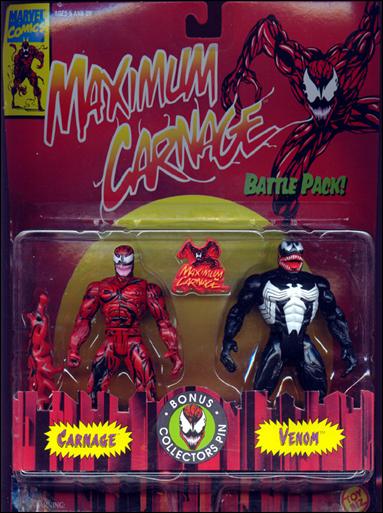
In the same summer that people were blasting 2Pac's Strictly 4 My N.I.G.G.A.Z. and Primus' Pork Soda, Marvel released one of the most famous, controversial, bestselling Spiderman story arcs ever; Maximum Carnage. Stretched out over the period of four months and fourteen issues, it was the biggest Spiderman crossover up to that time, and it completely destroyed the separate nature of each Spiderman comic series, a trend that would continue with arcs such as The Clone Sage and The Gathering of Five. The story's first part was the debut issue of the double-size Spiderman Unlimited, which came out every three months and continued in circulation until the 1999 reboot.

Hot on the heels of the "death" of Harry Osborn, the story centers around the psychopathic villain Carnage breaking out of jail, assembling a crew of equally bloodthirsty villains, and proceeding reek havoc in NYC. To take them down, Spiderman puts together his own coalition of heroes and anti-heroes. Things get even uglier when Shriek users her emotion-manipulation powers to cause New Yorkers to start rioting, and a portion of Spiderman's allies break off the fight Carnage on their own terms. Against the backdrop of this is the drama unfolding among Peter's friends and family, particularly over the repercussion of Harry's death, the return of Peter's "parents," and Peter's promise to MJ to avoid as much fighting as possible. The series deals heavily with the debate over whether the ends justify the means.
Maximum Carnage is most definitely an unintentional period piece, as the fashions, outlook, and bits and pieces of slang are firmly set in the early 90s.
Despite being a top-seller, reactions to the story have been mixed. Some see it as fun crossover which combined classic Spiderman and Marvel characters with lesser-known heroes and villains, and which did a good job in juxtaposing Silver Age idealism with Dark Age cynicism. Many others see it as the worst of 90s decadence and bad comic book storytelling (aside from The Clone Saga of course), and which glorified brutality over morality. Regardless of where one falls, one can't deny that it is of the most famous and iconic Spiderman stories of all time.
Maybe even better known than the comic itself was it's video game adaptation for Sega Genesis and Super Nintendo, a popular side-scroller beat-em-up where you battle Carnage and his crew, as well as hundreds deranged rioters, choosing at different points to play as either Spiderman or Venom.
To celebrate the 20th anniversary of this story, I'm gonna be looking at each issue of the series, as well as the Genesis video game (I haven't played the SNES version), and the story's legacy.
Just remember that